14 Dec 2023

Robert Frost's Christmas Cards


Our call for submissions for the January 2024 issue is about "personal" holidays which do not get on official calendars and probably don't get you a day off from work or cards and gifts. But I thought of how Robert Frost sent out Christmas poem “cards” from 1929 to 1962.

Each year, Frost would select a poem and often write an original piece for the occasion. he sent them to some friends and loved ones. Later they went out to his publisher’s friends and loved ones. If you were lucky enough to be on that list and still have them, they are collectors’ items.

They began as just his way to honor the winter season with a poem. One poem used was "Christmas Trees." (an excerpt below)

...He proved to be the city come again 
To look for something it had left behind   
And could not do without and keep its Christmas. 
He asked if I would sell my Christmas trees; 
My woods—the young fir balsams like a place 
Where houses all are churches and have spires. 
I hadn't thought of them as Christmas trees.   
I doubt if I was tempted for a moment 
To sell them off their feet to go in cars 
And leave the slope behind the house all bare, 
Where the sun shines now no warmer than the moon...
 

Frost, 1929 (by Doris Ulmann, national Portrait Gallery)

Joseph Blumenthal headed Spiral Press during those years. Without Frost's knowledge, while working on an edition of Frost’s poetry in 1929, he printed 250 copies for friends and colleagues of “Christmas Trees.” When the poet saw the publication, his first response was not to sue him but to request a few copies to send out to his own family members. And so, the annual tradition was born.

The last Christmas mailing contained "The Prophets Really Prophesy as Mystics, the Commentators Merely by Statistics” which went out with 16,555 copies. 

The collection would feature other classic poems by Frost, including “Birches,” “A Boy’s Will,” and “The Wood-Pile”

"Christmas Trees" is no Hallmark greeting card, but it ends with this Christmas wish:   

A thousand Christmas trees I didn’t know I had!
Worth three cents more to give away than sell,
As may be shown by a simple calculation.
Too bad I couldn’t lay one in a letter.
I can’t help wishing I could send you one,
In wishing you here with a Merry Christmas.

More about the cards at poets.org/text/robert-frosts-christmas-cards


Follow this blog for all things poetry.
To see our past prompts and more than 300 issues,
visit our website at poetsonline.org


from Poets Online - the blog https://ift.tt/n10pTQU

7 Dec 2023

Prompt: Personal Holidays


December is a big month for holidays both religious, pagan and secular. Many people love these holidays and spend a lot of time and money celebrating them. But not everyone is a fan of these "official" holidays.

In the poem "A New Law" by Greg Delanty, he proposes:

Let there be a ban on every holiday.
No ringing in the new year.
No fireworks doodling the warm night air.
No holly on the door. I say
let there be no more.
For many are not here who were here before.

I wouldn't propose that radical of a change in holidays, but I understand the sentiment.

For this December call for submissions in the 25th year of Poets Online, we are looking for poems about personal holidays. These are the holidays that perhaps only you celebrate. They are not on official calendars but they might be on your personal calendar. Not birthdays, anniversaries, national holidays, or religious holy days, not even Festivus.

In Galway Kinnell's poem "The 26th of December" he marks the day after Christmas not as being connected to that holiday but as" A Tuesday, day of Tiw, / god of war." Not exactly what most people would connect to the day after Christmas.

He celebrates the short day by

"talking by the fire,
floating on snowshoes among
ancient self-pollarded maples,
visiting, being visited, giving
a rain gauge, receiving red socks,
watching snow buntings nearly over
their heads in snow stab at spirtled bits
of sunflower seeds the chickadees
hold with their feet to a bough
and hack apart, scattering debris
like sloppy butchers"

It is a short holiday, one day and in a season of short days. And when it is over, " Irregular life begins" again, as with many holidays.

"Telephone calls,
Google searches, evasive letters,
complicated arrangements, faxes,
second thoughts, consultations,
e-mails, solemnly given kisses."

Give us a poem about your personal holiday. Why do you mark the day(s) and how do you celebrate? (If celebrate is even what you do.) 

Submission Deadline: December 31, 2023   Happy New Year!


Galway Kinnell was an award-winning poet best known for poetry that connects the experiences of daily life to much larger poetic, spiritual, and cultural forces. Kinnell was born in 1927 in Providence, Rhode Island and grew up in Pawtucket. A self-described introvert as a child, he grew up reading reclusive American writers such as Edgar Allan Poe and Emily Dickinson. After two years of service in the U.S. Navy, he earned a BA in 1948 from Princeton University where he was classmates with poet W.S. Merwin. He earned an MA from the University of Rochester a year later.

Of his first books, What a Kingdom it Was (1960), Flower Herding on Mount Monadnock (1964) and Body Rags(1968) which contains the bulk of Kinnell’s most praised and anthologized poems. Selected Poems (1982), for which Kinnell won the Pulitzer Prize and was co-winner of the National Book Award in 1983, contains works from every period in the poet’s career and was released just shortly before he won a prestigious MacArthur Foundation grant. Kinnell released the retrospective collection, A New Selected Poems (2001), focusing on poetry of the 1960s and 1970s, and his Collected Poems was published in 2017.
Kinnell lived in Vermont for many years. He died in 2014 at the age of 87.


Follow this blog for all things poetry.
To see our past prompts and more than 300 issues,
visit our website at poetsonline.org


from Poets Online - the blog https://ift.tt/OPyHkIw

28 Nov 2023

The Visions of William Blake

Blake's illustration of angels guarding Jesus in the sepulchre 


November 28 is the birthday of poet and artist William Blake, born in London in 1757. He was four years old when he had a vision that God was at his window. A few years later, he went for a walk and saw a tree filled with angels, their wings shining. He had other visions, too: he saw the prophet Ezekiel sitting under a tree, and angels walking with farmers making hay.

While some aspects of his behavior and beliefs might be considered eccentric or even insane by conventional standards, it's better to approach the question of his mental state with some sensitivity and historical context.

During Blake's time (1757-1827), the understanding and classification of mental health were different from contemporary perspectives. There is no definitive evidence to suggest that Blake was clinically insane. However, he did experience visions and claimed to have mystical experiences, which heavily influenced his artistic and poetic creations. Blake's unique worldview and his incorporation of spiritual and visionary elements in his works are more often seen as products of his unconventional thinking and artistic genius rather than indicators of mental illness.

When Blake was 10 his parents sent him to drawing school, and at the age of 14, he was apprenticed to an engraver. After seven years, he went into business for himself, and a few years later he privately printed his first book, Poetical Sketches (1783 which was a total flop. The book wasn't even mentioned in the index of London's Monthly Review, a list of every book published that month.

Not long after that, Blake's beloved brother, Robert, died at the age of 24. Blake spent two sleepless weeks at his deathbed, and when he died, Blake claimed that he saw his brother's spirit rise through the ceiling, clapping its hands with joy. From then on, Blake had regular conversations with his dead brother. 

A year later, Robert appeared to William in a vision and taught him a method called "illuminated printing," which combined text and painting into one. Now known as relief etching, it was a huge breakthrough in printing. Blake printed his own Songs of Innocence (1789), Songs of Experience (1794), The Marriage of Heaven and Hell (1790), and The Book of Los (1795). 

Blake died at the age of 69. He spent the day of his death working on a series of engravings of Dante's Divine Comedy. That evening, he drew a portrait of his wife, and then told her it was his time. A friend of Blake's who was there at his deathbed wrote: "He died on Sunday night at 6 o'clock in a most glorious manner. [...] Just before he died, His Countenance became fair. His eyes Brighten'd and He burst out into Singing of the things he saw in Heaven."

At the time of his death, Blake was an obscure figure, best remembered for his engravings of other peoples' work, or maybe his one famous poem, "The Tyger." Among those who knew more about his life's work, the consensus was that Blake was insane. Songs of Innocence and of Experience, which he had engraved and painted by hand, had sold fewer than 20 copies in 30 years. 

It wasn't until more than 30 years after his death that a husband-and-wife team, Alexander and Anne Gilchrist, published a two-volume biography of Blake that firmly established him as a brilliant and important artist.

Throughout his career, he continued to see visions — in addition to communing with the spirits of relatives and friends, he claimed to be visited by the spirits of many great historical figures, including Alexander the Great, Voltaire, Socrates, Milton, and Mohammed. He talked with them and drew their portraits. He was also visited by angels and once by the ghost of a flea, whose portrait he drew. 


Blake wrote:

"I assert for My Self that I do not behold the outward Creation [...] 'What,' it will be Question'd, 'When the Sun rises, do you not see a round disk of fire somewhat like a Guinea?' O no, no, I see an Innumerable company of the Heavenly host."

"First the notion that man has a body distinct from his soul is to be expunged: this I shall do by printing in the infernal method by corrosives, which in Hell are salutary and medicinal, melting apparent surfaces away and displaying the infinite which was hid."

 "Without minute neatness of execution, the sublime cannot exist! Grandeur of ideas is founded on the precision of ideas."


Follow this blog for all things poetry.
To see our past prompts and more than 300 issues,
visit our website at poetsonline.org


from Poets Online - the blog https://ift.tt/keuXzqd

9 Nov 2023

The Romance of That Little Notebook in the Cafe


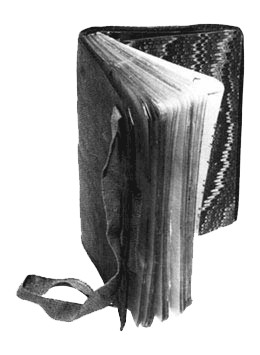
Moleskine. There is something about using that little black notebook and knowing all the writers and artists who have used it before you - Hemingway, Picasso, Van Gogh (that's one of his over there on the right), Bruce Chatwin, Matisse, Neil Gaiman...

Sketches in words or lines, notes, stories, poems, ideas, overheard dialogue.

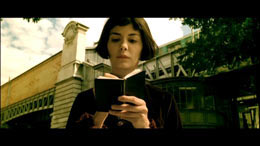
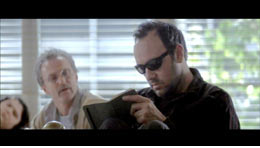
You see it in films. Isn't that Amelie holding one? And even Prot (and he's from K-PAX - the other planet I want to visit) has one.

Sometimes it's used as a generic term for little soft black notebooks, the real Moleskine (pronounced mol-a-skeen-a) is a brand of notebook now manufactured by Modo & Modo, an Italian company.

Bound in oilcloth-covered cardboard (the "Moleskin"), it has an elastic band to hold the notebook closed and a sewn spine so that it lies flat when opened. It comes in several sizes, with lined or unlined papers.

Bruce Chatwin used them in his travels and in the mid-1980s when his Paris source ran out, he discovered that they were no longer being made by the original manufacturer. They are back though and made in the same shapes and styles.

I'm a sucker for notebooks and journals. I always felt an optimism for the new school year with that fresh notebook in hand. Give me a Moleskine and put me in a street cafe or bar (even a Panera or Starbucks will do it) and I feel some ex-pat writer being channeled through me. Now, I'm not saying that it creates great writing, but it creates mood.

As readers of this blog already know, I have small books for small poems but I have a number of these notebooks from their catalog for different purposes.

If you have never owned one, drop by a little bookstore or Amazon, buy one, and give it a try.


from Poets Online - the blog https://ift.tt/e2XER7p

3 Nov 2023

Prompt: Love Poem to Yourself


Woman at Mirror by Gerard ter Borch 1652

Louise Glück (pronounced ɡlɪk) died October 13, 2023, at the age of 80. She was a highly praised and awarded American poet and essayist. She won the 2020 Nobel Prize in Literature, the Pulitzer Prize, the National Humanities Medal, the National Book Award, the National Book Critics Circle Award, and the Bollingen Prize. From 2003 to 2004, she was the Poet Laureate of the United States.

Despite all those awards, I will admit to not being very familiar with her poetry. I never heard her read in person and I don't have any of her books on my shelf. After her death, there were many posts online about her and copies or links to her poems and interviews.

The poem of hers that caught my attention is a short one titled "Crossroads." I read it as a love poem to the self, written at an advanced age when one is considering their own death. 

I watched an interview with her and learned a lot more about her life and work which made the poem richer on my next reading. 

 “Crossroads,” originally published in her 2009 book A Village Life, so she was still 14 years from her death. maybe she was contemplating death. Maybe she had an illness. In the poem, she looks at her body - not uncommon as we age - but also at her soul. She says that " it is not the earth I will miss / it is you I will miss."

"Self love" sounds selfish. But so many people don't love themselves. Therapists deal with that every day. 

Listen to her read the poem and look at it on the page. Then, consider writing a love poem to yourself. What is it that you love about yourself? What will you miss about yourself? Do you already miss something you once loved about yourself?


Follow this blog for all things poetry.
To see our past prompts and more than 300 issues,
visit our website at poetsonline.org


from Poets Online - the blog https://ift.tt/yTrHSRE

The Alarming Spread of Poetry


P.G. Wodehouse is Sir Pelham Grenville Wodehouse, KBE (1881 – 1975) and he was an English author and one of the most widely-read humorists of the 20th century. wrote "The Alarming Spread of Poetry."  Do you think he was being sarcastic?
To the thinking man, there are few things more disturbing than the realization that we are becoming a nation of minor poets. In the good old days, poets were for the most part confined to garrets, which they left only for the purpose of being ejected from the offices of magazines and papers to which they attempted to sell their wares. Nobody ever thought of reading a book of poems unless accompanied by a guarantee from the publisher that the author had been dead at least a hundred years. Poetry, like wine, certain brands of cheese, and public buildings, was rightly considered to improve with age; and no connoisseur could have dreamed of filling himself with raw, indigestible verse, warm from the maker.


from Poets Online - the blog https://ift.tt/1girJUP

16 Oct 2023

Prompt: Surprise

"Lying in a Hammock at William Duffy’s Farm in Pine Island, Minnesota" by James Wright is our model poem this month. Wright's short poem is primarily a description of a country setting. He sees a farm, viewed from a hammock. It is a pleasant, relaxing scene.

The poem is a single stanza, free verse, in simple language. It has 13 lines - one short of a sonnet. But like a sonnet, it has a "turn" - a quick one in its final line. It is almost like the poem is a sonnet without the final concluding heroic couplet. That final line is a surprise ending - a twist that seems to undo the previous 12 lines.

My reading of the poem is that the person in the hammock is a visitor to Duffy's farm. It is not where he lives and different from where he does live. The scene around him is pleasant and the visitor's conclusion comes from that scene, but in an unexpected way.

For our November issue, we are looking for poems with a surprise ending, a twist, or a poem that ends in a way that flips the poem's meaning.

Submission Deadline: October 31, 2023


Follow this blog for all things poetry.
To see our past prompts and more than 300 issues,
visit our website at poetsonline.org


from Poets Online - the blog https://ift.tt/XOPUswE

The Cento

street wall collage   -   Photo:PxHere The cento is a poetry form that I used with students but that I haven't used myself o...