In a poetry workshop I had with Thomas Lux, he said "All poems are ars poetica." I know Lux didn't mean that literally, but many poems are about poetry in some way. Former Poet Laureate Robert Pinsky said, "All of my poems are about history." I wonder how literally he meant us to take that statement.
History can mean the whole series of past events, but those events are always connected with someone or something. Look at some of Pinsky's poems, such as "Shirt," or "From The Childhood of Jesus," and you know those poems are about that larger history.
Stanley Kunitz at age 95 became our tenth Poet Laureate in 2000. I have heard him read his poem " Halley's Comet," with the energy of that young boy who is thrilled and frightened on the rooftop. The poem takes us from the ground, up the stairs, onto the roof and, as he calls his father, the reader rises into that starry sky. (Kunitz's father committed suicide before Stanley had the chance to know him.)
What I like about Kunitz's poem is that it mixes the historical appearance of the comet in 1910 with his personal history and also some of his family history. (Halley's comet will next appear in the night sky in the year 2062
For this month's prompt, select a historic event as the starting point for a poem. Do not write only about the event, but also on your personal history and your connection to it. Is there an event that triggers a personal history because of when it occurred? The history lesson here is personal.
Watch and listen to this video where Kunitz talks about history and his poetry. This Bill Moyers video was recorded at one of the Dodge Poetry Festivals in New Jersey where I heard him read "Halley's Comet" and many of his other poems.
Peter Paul Rubens - L’enlèvement de Proserpine (The Rape of Proserpina, 1638)
Proserpina is the Latin name for the Greek goddess Persephone.
Recently, I listened to the NY Times Book Review podcast with Stephen Fry on Reimagining the Greek Myths. Fry's latest book is a second about the Greek myths. In Heroes: The Greek Myths Reimagined , a sequel to his Mythos, Stephen Fry moves from the exploits of the Olympian gods to the deeds of mortal heroes.
What interested me in Fry's sequel is that these are not the stories of the gods but of the mortal humans who sometimes live in the favor of the gods and goddesses, and sometimes are punished by them. Some of their names are also well known: Perseus, Jason, Atalanta, Theseus, Bellerophon, Orpheus, Oedipus, Theseus and Heracles.
When I first encountered the myths as a young student, I took a liking to Prometheus who stole fire and gave it to the mortals on Earth. That really pissed off Zeus who saw this as the beginning of the end for the gods.
"...Prometheus himself – the Titan who made us, : befriended us and championed us – continues to endure his terrible punishment: shackled to the side of a mountain he is visited each day by a bird of prey that soars down out of the sun to tear open his side, pull out his liver and eat it before his very eyes. Since he is immortal the liver regenerates overnight, only for the torment to repeat the next day. And the next.
Prometheus, whose name means Forethought, has prophesied that now fire is in the world of man, the days of the gods are numbered. Zeus’s rage at his friend’s disobedience derives as much from a deep-buried but persistent fear that man will outgrow the gods as from his deep sense of hurt and betrayal.
Prometheus has also seen that the time will come when he will be released. A mortal human hero will arrive at the mountain, shatter his manacles and set the Titan free."
Who saves Prometheus from this torment? The Greek hero, Heracles, frees him (though with Zeus's permission). Saved by a mortal.
The podcast and book got me thinking about how myths are used in poetry.
Standing in the harbor holding a book and lifting a torch
Among us her name is Liberty
She has many names and she is everywhere
You can also find her easily
Inside yourself—
Don’t be afraid—
Just do whatever she tells you to do
In that poem, the goddess seems to come to Earth as the Statue of Liberty. In "Selfie with Pomona: The Goddess of Abundance" by Alexandra Teague, we also encounter a goddess as a statue at the Pulitzer Fountain in New York City.
She has all the advantage. Two sculptors
for her single body. Bronze prepossession. Bare arms
muscled as if she plucked each apple in her basket,
then scythed the reeds to weave the basket—heaping on peaches
and pearls of snow. What seasons?
What death? She’s seamless as light...
Where’s the best light to look human?
But the book of poetry I thought of is Mother Love by Rita Dove who takes Demeter and Persephone out of the Greek myths and sets them into Arizona, Mexico, and a bistro in Paris. She retells this mother-daughter story in our world.
Rita Dove has said that she thinks of her verse-cycle as a "homage and as counterpoint to Rilke’s Sonnets to Orpheus.” You could choose almost any one of the poems from the book as a model for this month's prompt, such as "Persephone, Falling."
I chose "Hades' Pitch", in which the god of the dead and the king of the underworld that bears his name makes a pitch to Persephone.
If I could just touch your ankle, he whispers, there
on the inside, above the bone—leans closer,
breath of lime and pepper—I know I could
make love to you. She considers
this, secretly thrilled, though she wasn’t quite
sure what he meant...
Persephone is the daughter of Zeus and Demeter, goddess of the earth. Hades abducts the young goddess one day as she is gathering flowers by a stream. Demeter goes in search of her daughter but is unable to find her. Demeter’s grief causes the earth to die — crops fail, and famine comes upon the land. Zeus intervenes and commands Hades to return Persephone. Reluctant to release her, Hades forces Persephone to eat a pomegranate seed, food of the dead. As a result, she can spend only six months out of the year with her mother, and the other six months she is destined to spend in the realm of Hades. To the Greeks, the return of Persephone from the underworld symbolized the return of life in the spring.
This month's prompt is to reimagine a myth or mythological character in our own world or in a modern situation. Is there a god, goddess or mortal from mythology that connects to your life?
Here, I have focused on Greek and Roman myths but you can look to myths from other cultures. And though I do like tales of the poor mortals mixed up with the immortals, the choice is yours. Include in your poem's title a clear reference to the character or myth you are reimagining.
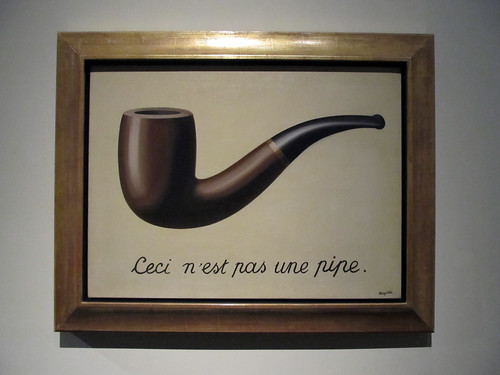
Magritte's "The Treachery of Images" with its caption "This is not a pipe"
If only life had an undo button.
In Linda Hillrinhouse's poem "Tatiana" (from The Things I Didn't Know to Wish For, NYQ Books, 2020), the speaker wants to go back to a time and undo one-by-one a series of related actions.
I like Mark Yacich's poem that begins "You are not a statue / and I am not a pedestal. / We are not a handful / of harmless scratches on a pale pink canvas..." which makes me think of Billy Collins' "Litany" with its list of things that someone both are and are not.
That listing is also used in Dan Albergotti's "Among the Things He Does Not Deserve" which is catalogs things undeserved ranging from "Greek olives in oil, fine beer" to the final "soft gift of her parted lips."
René Magritte's famous piece "The Treachery of Images" with its caption "This is not a pipe" is a commentary on artistic illusion. The pipe is not a pipe: it's a painting of a pipe. Korzybski's "The word is not the thing" and "The map is not the territory" and Diderot's "This is not a story" live in the same place. And so it is with the "treachery" of images in poems - things are often not literally what the poet says that they seem to be.
Girl Behind Branches by Linda Hillringhouse
Linda Hillringhouse's poem takes this negation further. The voice of the poem not only confronts the truth of a time in her life that is painful to remember but finally tries to speculate on the driving force behind this truth that she wishes to undo.
Your poem for this month might use "not" in its title, or be a series of negations, but it should also try to address a particular subject and expose a reason for the undoing.
I wasn't a big fan of fairy tales as a child and I didn't read many of them to my own children. They can be pretty cruel and violent.
When I was a college student, a book by Bruno Bettelheim, a 20th-century child psychologist, was very popular in literature and education classes. That book is The Uses of Enchantment: The Meaning and Importance of Fairy Tales, a study of fairy tales and their universal importance in understanding childhood development. His examples include stories like "The Three Little Pigs,” “Hansel and Gretel,” and “The Sleeping Beauty.” Bettelheim admits that the tales are often cruel but that they do help teach lessons about finding meaning for one’s life.
Our prompt for June is a poem that tries one of these four paths through fairy tales:
based on a fairy tale, based on characters appearing in those tales, a new fairy tale, or a poem using the conventions of fairy tales.
"Mermaid Song" by Kim Addonizio finds a fairy tale character lying on her sofa.
Damp-haired from the bath, you drape yourself
upside down across the sofa, reading,
one hand idly sunk into a bowl
of crackers, goldfish with smiles stamped on...
Alicia Ostriker's poem "Utopian" is about a new fairy tale world created by a child that the poet then needs to interpret.
My neighbor’s daughter has created a city
you cannot see
on an island to which you cannot swim
ruled by a noble princess and her athletic consort
all the buildings are glass so that lies are impossible
beneath the city they have buried certain words
which can never be spoken again
chiefly the word divorce which is eaten by maggots...
"From the Country Notebooks" by Geffrey Davis uses some fairy tale conventions - including "once upon a time" and some of that violence, but the tale is very real.
Once upon a time, my father was offered a shovel
and ten minutes alone with the prized stallion—Just don’t
kill him. Once upon a time, I asked about the apple-
knotted scar on my father’s back shoulder, as he dressed
for work: That’s from when Sammy tried to kill me.
Remember? Once upon a time, my father accepted a shovel
and the problem of answering violence without loosing
too much blood from Sammy’s chestnut body, nervous
in the stable. Once upon a time...
Though we think of fairy tales are meant for children as a way to help them solve problems such as separation anxiety, oedipal conflict, and sibling rivalries, your poem will probably be meant for adults.
Whitman at age 35, image used as the frontispiece to Leaves of Grass - a steel engraving by Samuel Hollyer
from a lost daguerreotype by Gabriel Harrison
The daily Writer's Almanac reminded me that today is the birthday of the poet Walt Whitman. He was born in West Hills, Long Island, New York (1819) and he lived in many places but he lived out the last part of his life in Camden, New Jersey until his death in 1892.
My first memory of Whitman was reading his short poem "When I Heard the Learn’d Astronomer" which was in the high school sophomore anthology we used in English class.
When I heard the learn’d astronomer,
When the proofs, the figures, were ranged in columns before me,
When I was shown the charts and diagrams, to add, divide, and measure them,
When I sitting heard the astronomer where he lectured with much applause in the lecture-room,
How soon unaccountable I became tired and sick,
Till rising and gliding out I wander’d off by myself,
In the mystical moist night-air, and from time to time,
Look’d up in perfect silence at the stars.
That poem resonated with me. That person in the astronomer's lecture who gets bored and going outside and seeing the stars of that lecture and is much more pleased and in awe, reminded me of me. At first, I identified as a high school student and later as a college student in a classroom bored with theories and wanting practices. I also began to understand that people interpreting poems, literature, songs, art, films, and the natural wonders of Earth and the universe were far less interesting than the things they were interpreting.
I will admit that I didn't love Whitman's much more famous Leaves of Grass which is often mistakenly thought of as a single poem but is a collection of poems that are loosely connected. It is considered an American classic.
Walt was really into self-promotion with Leaves of Grass. In 1842, Charles Dickens came to America for a tour and is sometimes credited for started the book tour. He could reasonably have been billed as the most famous writer in the world after Oliver Twist and The Pickwick Papers. Perhaps, Walt had that in mind when he published the first edition of Leaves of Grass in 1855.
Though self-publishing your writing once had a bad name (still does, sometimes) Whitman did so with the collection. He even did most of the typesetting for the book himself. He wanted the book to be small enough to fit in a pocket. He paid for the publication of 795 copies. He was 37.
It might surprise a 2020 reader that some of those poems were criticized for being openly erotic. Reviewers at the time said it was “a mass of stupid filth” that promoted “that horrible sin [homosexuality] not to be mentioned among Christians" and that it was “full of indecent passages” and that Whitman himself was a “very bad man” and a “free lover.”
Henry Thoreau, not a fan, wrote, “It is as if the beasts spoke” but his friend and mentor Ralph Waldo Emerson said the collection was “the most extraordinary piece of wit and wisdom America has yet contributed.”
Whitman was always revising. He added 146 poems to his third edition. He spent those New Jersey years revising and expanding the collection until the 1891 eighth and final edition.
Walt had no social media for self-promotion but he had a journalism background. In 1855, he got at least three anonymous positive self-reviews of the first edition of Leaves of Grass in the United States Review, the American Phrenological Journal, and the Brooklyn Daily Eagle. The one gain with an overly confident statement that we have "An American bard at last!"
What Walt did is no secret. He was discovered early on. In 1856 Leaves, a reviewer in the New York Times identified Walt as the author of the three anonymous reviews. Whitman reprinted the "exposé" with the original self-reviews in a publicity pack along with the 1860 edition.
Whitman was open about those reviews and his self-promotion and viewed it as he did the initial self-publication - a necessary way to get his work out to the public.
I think if Walt had been writing in the 21st century, he would be on Twitter, Instagram and Facebook, posting videos on YouTube and offering his book's first edition as an Amazon Original. Walt would have loved the self-promotion of social media. And today he might be an openly gay author but when he was asked about his sexuality even at the end of his life, he declined to answer. At the end of his life he said that sex was “the thing in my work which has been most misunderstood — that has excited the roundest opposition, the sharpest venom, the unintermitted slander, of the people who regard themselves as the custodians of the morals of the world.”
He was unorthodox in his life, his writing and his way of creating the image of the "The Gray Poet" not unlike a modern-day Bob Dylan or any celebrity artist who has created a persona that mixes reality and fiction.
In the film Dead Poets Society, Mr. Keating (Robin Williams) alludes to Whitman's poem "O Captain! My Captain!" and other passages from Leaves of Grass. When Keating is fired from the school because his unorthodox teaching, his students use the poem to salute him.
I rediscovered some of the Whitman poems individually through other sources. "I Sing the Body Electric" came back to me through Ray Bradbury using it as the title of a short story and the title of his story collection. Earlier it had been the title of a Bradbury episode written for The Twilight Zone in 1962. Of course, I went back to the poem and though it had not changed, I had and so did my appreciation of the poem.
That poem is a good example of the versions of the poems in the collection. Originally, like the other poems in Leaves of Grass, it did not have a title and it didn't have the line "I sing the body electric" until the 1867 edition because "electric" was not a commonly used term in 1855.
Last summer was the 200th birthday of Whitman. I went to an exhibit at The Morgan Library and Museum in New York, "Walt Whitman: Bard of Democracy," much of which was about Leaves of Grass.
About 20 years ago, I visited Whitman's New Jersey home in Camden which is now maintained by the state. Touring the modest home wasn't inspiring. Unlike some other author's homes I have visited, I didn't feel Walt's energy there.
I'm reading poet Mark Doty's new book, What Is the Grass: Walt Whitman in My Life, which begins with Mark's visit to the home. It's about the connections he has made personally with the poet and Leaves of Grass. His visit also seemed to be less inspiring than expected, but he works his way through the poems and Walt's life and looks for how it has influenced his own life and work. It's an interesting journey.
While we are all at home quarantining and poets are doing readings online and a few writers are doing their "book tours" virtually. I have been watching the daily videos from Billy Collins. They are very informal conversations and he reads his poems and poems by others. It's a low-tech iPhone production, but then so are some major newscasters and late-night TV guests.
At the end of today's "broadcast" (his term), he gave an "assignment" to read a poem before the Friday session. He said this was the poem he used when asked that impossible question "What is your favorite poem?"
I was surprised that his choice is "This Lime-tree Bower my Prison" by Samuel Taylor Coleridge. I had never read the poem before, but I can see that it is appropriate to a time when we are separated from friends and perhaps from nature and experiences.
You might want to read the poem and then join the live Facebook broadcast on Friday and add your comments.
These past few weeks I have had a hard time focusing on any sustained reading, so I Have returned to an anthology of haiku. Most people are familiar with the form and the 5-7-5 syllable structure. Those three lines of 5 syllables, 7 syllables, and another 5 syllable line are not always maintained.
In Japanese, haiku does use those 17 syllables but instead counts sound. We would count the word “haiku” as two syllables in English, but it is three sounds in Japanese (ha-i-ku).
This month we are using the haiku form with a strict 5-7-5 syllables. We will also follow several other form "rules." Classic haiku is nature-based and often seasonal. No rhymes. Classical haiku also employs a cutting word (kireji in Japanese) that makes a verbal punctuation mark that separates the typically two juxtaposed images of the poem. In English, we don't have kireji so poets sometimes use a dash to make a pause so that readers can reflect on the connection between the two parts. That a good idea because a haiku can be read and digested too quickly.
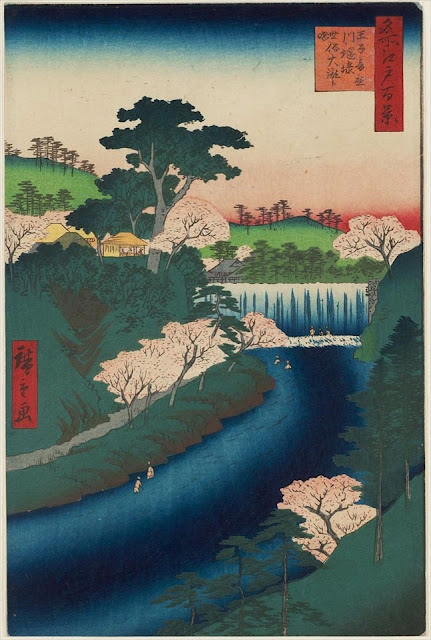
Translations of Japanese haiku into English vary greatly. There is a poem by the master Matsuo Basho’s (1644-1694) that reads in Japanese as:
This is a version described as "translated as a Zen koan”
the bungling frog
leaped for the pond, but landed
in Basho’s brain
Our haiku prompt this month is to write a sequence of 3 or more related poems. I have seen several variations on this kind of sequence. It can be 3 poems on the same thing. I have seen poems connected by using the last word of one as the first word of the next (still possibly connected by theme) and several poems constructed using the same words in new constructions.
As a model, I chose three spring poems by Basho that are connected by the season but also by blossoms which are very often used in haiku to indicate spring. These are my own translation and I have adhered to the 5-7-5 form. (Note: "ume" means plum)